Pangea
Wolfgang Fahl
⚠️ LLM-generated content notice: Parts of this page may have been created or edited with the assistance of a large language model (LLM). The prompts that have been used might be on the page itself, the discussion page or in straight forward cases the prompt was just "Write a mediawiki page on X" with X being the page name. While the content has been reviewed it might still not be accurate or error-free.
see KG Explorer for the principle
Continental Drift Knowledge Representation Research[edit]
This page discusses different approaches to representing the evolution of continents from Pangea to present day configurations, focusing on knowledge representation methods and their comparative analysis.
Research Approach[edit]
The research combines top-down and bottom-up ontology development approaches to study continental drift representation:
Top-Down Approach Using LLMs[edit]
- Utilizing Large Language Models for concept extraction
- Developing hierarchical relationships
- Identifying temporal and spatial patterns
- Documenting reasoning processes
Bottom-Up Approach Using Wikidata[edit]
- Starting from Wikidata's Pangea node (Q4398)
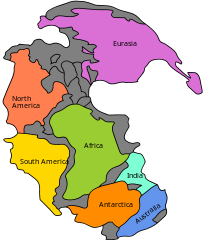
- Mining related properties and relationships
- Analyzing successor landmasses
- Mapping temporal relationships
- Understanding existing classification schemes
Knowledge Representation Methods[edit]
Description Logic Approach[edit]
Example:
Landmass ⊑ GeologicalEntity
hasName ⊑ DataProperty
hasArea ⊑ DataProperty
Landmass ⊑ ∃hasName.String ⊓ ∃hasArea.Float
hasPredecessor ⊑ ObjectProperty
hasSuccessor ⊑ ObjectProperty
Limitations:
- No direct support for methods/functions
- Limited attribute support
- No built-in temporal reasoning
- Complex ancestry tracking
UML Model Approach[edit]
Key Classes:
- Landmass
- GeologicalEvent
- SplitEvent
- MergeEvent
- TimeRange
- GeoCoordinate
Advantages:
- Clear representation of relationships
- Support for methods and attributes
- Easy implementation path
- Natural temporal modeling
- Straightforward data storage options
Comparative Analysis Framework[edit]
Evaluation Criteria[edit]
- Modeling Power
- Temporal representation
- Spatial relationships
- Historical uncertainty
- Causality representation
- Implementation Aspects
- Development complexity
- Query capabilities
- Performance characteristics
- Scalability
- Data integration
- Scientific Considerations
- Formal verification
- Property provability
- Scientific reproducibility
- Extensibility
Research Focus[edit]
The primary research investigates misalignments between top-down (LLM-derived) and bottom-up (Wikidata-derived) ontologies, examining:
- Structural differences
- Missing concepts
- Conflicting relationships
- Temporal representation variations
- Classification discrepancies
- Granularity differences
Implementation Approaches[edit]
Several implementation strategies could be considered:
- OWL/SPARQL endpoint
- Object-oriented application with YAML storage
- Graph database implementation
- Domain-specific language development
- Mathematical model using differential equations
- GIS-specific modeling